
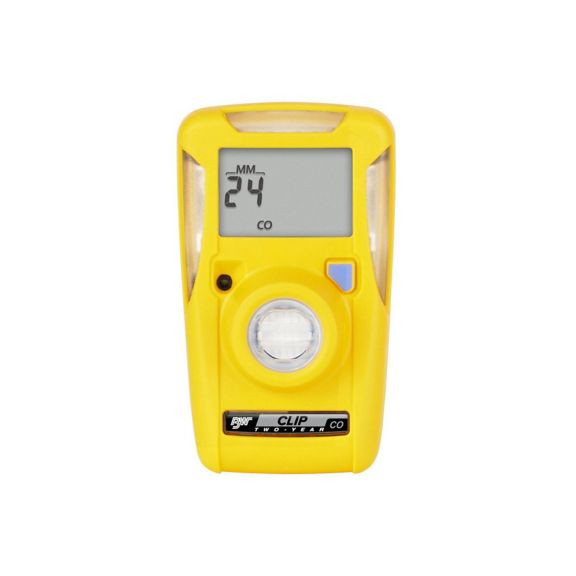

Description
- Maintenance-free: no sensor or battery changes necessary
- Offers extended longevity with a 2-year field-replaceable battery and sensor
- Compact, lightweight design with one-button operation
- Designed for a range of harsh environments and extreme temperatures
- Hibernation mode with case accessory or IntelliDoX
- Automated self-test of battery, sensor and electronics
- Wide-angle flash, which alerts simultaneously with audible and vibrating alarm
- Automatic logging of the 35 most recent gas events and bump test results
- Compatible with MicroDock II and Fleet Manager II software
- Affordable, with low cost of ownership
- Bump testing (qualitative function check) of the sensors, is a recommended function and requires test gas cylinders and bump test accessories
- Note: This monitor does not have a continuous display of the gas concentration, the concentration of the gas will only be displayed when an alarm point is reached
Specifications
- No. Of Detectable Gases: Single
- Hazard: O2
- Alarm Setpoints: 19.5%-23.5%
Catalog Page & Resources
Related Products
Related Products

BWCLIP 2 year SO2 5-10 | BW | Honeywell
Honeywell
$680.40
Maintenance-free: no sensor or battery changes necessary
Offers extended longevity with a 2-year field-replaceable battery and sensor
Compact, lightweight design with one-button operation
Designed...

BWCLIP 2 YEAR H2S 10-15 | BW | Honeywell
Honeywell
$283.82
Maintenance-free: no sensor or battery changes necessary
Offers extended longevity with a 2-year field-replaceable battery and sensor
Compact, lightweight design with one-button operation
Designed...

BWCLIP 2 year CO 35-200 | BW | Honeywell
Honeywell
$289.67
Maintenance-free: no sensor or battery changes necessary
Offers extended longevity with a 2-year field-replaceable battery and sensor
Compact, lightweight design with one-button operation
Designed...

Replacement 3 Year O2 Sensor | BW | Honeywell
Honeywell
$525.29
Replacement oxygen (O2) sensor (for use with GasAlertMax XT II)
Long life and Improved field reliability
3 Year Warranty
Specifications
Parts: Sensors
Manufacturer's Warranty
3 Years

Oxygen (O2) Sensor, MaxXTII / MicroClip XT / XL / Quattro / Micro 5 | BW | Honeywell
Honeywell
$494.10
Replacement oxygen (O2) sensor (for use with GasAlertMax XT II)
Compatible for use with GasAlertMicroClipXL, GasAlertMicroClipXT, and GasAlertMaxXT II
Long life and Improved field reliability
2 Year...