

Guardrail Systems
Fall Protection Guardrails: Passive Edge Protection for Industrial Worksites
What Are Guardrail Systems?
Guardrail systems — also called guard rail or safety railings — are engineered passive barriers that prevent workers from reaching an unprotected edge at an elevated work surface. A complete system consists of a top rail, a midrail, vertical posts, and optional toe boards, and protects any worker near the barrier without requiring the worker to take any action. Construction crews, facility managers, and rooftop contractors rely on fall protection guardrails to control edge hazards on roofs, mezzanines, open-sided floors, and stairwells.
All Safety supplies guardrail systems to industrial and commercial buyers across Canada.
Key Takeaways: Guardrail Systems and Edge Protection
- Guardrail systems deliver passive fall protection — they stop workers from reaching a fall hazard without requiring harnesses, lanyards, or training on arrest equipment.
- A standard guardrail system includes a top rail, intermediate midrail, vertical posts, and a toe board to contain dropped tools and materials.
- CSA Z259 series standards govern fall protection guardrail systems in Canada, establishing minimum rail heights, post spacing, and load requirements.
- Non-penetrating weighted-base guardrails protect roof membranes from puncture while still meeting CSA load resistance requirements for edge protection.
- Modular guardrail systems allow reconfiguration as site perimeters change, making them practical for multi-phase construction projects and warehouse layouts.
- Toe boards serve a separate function from the top rail: they block tools and materials from rolling off edges, protecting workers below the elevated surface.
- Guardrail systems cannot serve as anchor points for personal fall arrest systems — they are not rated for arrest forces and must not be used as tie-off locations.
Passive vs. Active Fall Protection: Choosing the Right Approach
Passive fall protection — guardrail systems and safety netting — stops workers from reaching a hazard. Active fall protection — harnesses, lanyards, and self-retracting lifelines — arrests a fall after it begins. Regulatory hierarchy under the CSA Z259 series requires employers to eliminate or guard hazards first; personal fall arrest systems apply where guardrails are not practicable. A guardrail is the preferred control because it protects every worker near the edge, regardless of whether they are wearing a harness.
Guardrail Systems vs. Personal Fall Arrest: Key Differences
| Attribute | Guardrail System | Harness and Lanyard / SRL |
|---|---|---|
| Protection type | Passive — no worker action required | Active — worker must don and connect equipment |
| Worker training required | Awareness of guardrail limitations only | Formal fit, inspection, and rescue training |
| Fall permitted | No — barrier prevents approach to edge | Yes — arrest occurs after fall initiates |
| Typical application | Rooftops, mezzanines, open-sided floors | Leading edges, steel erection, areas guardrail cannot reach |
Guardrails suit fixed, predictable edge hazards. When work tasks require workers to approach edges that a guardrail cannot guard — leading edges, steel erection, or confined access points — fall protection harnesses and self-retracting lifelines become the required control.
Types of Guardrail Systems: Permanent, Portable, and Non-Penetrating
Guardrail systems divide into three installation types based on how the post attaches to the surface. Permanent welded or bolted systems anchor directly to structural steel, concrete, or wood framing and suit long-term installations on mezzanines and platforms. Non-penetrating systems use a weighted base to achieve load resistance without puncturing a roof membrane. Portable modular guardrails use clamp, beam, or surface mounts and relocate between job sites or within a facility as work areas shift — common for construction site guardrail applications and plant turnarounds.
Guardrail System Components and System Types
- Top Rail
- The uppermost horizontal member of a guardrail system, positioned to resist outward and downward force and prevent workers from passing over the edge.
- Midrail
- An intermediate horizontal rail placed between the top rail and the walking surface, preventing workers from passing under the top rail.
- Toe Board
- A vertical barrier at the walking surface that blocks tools, materials, and debris from rolling off the elevated surface.
- Post
- A vertical structural member that supports the top rail and midrail, anchored to the surface at intervals determined by the system's rated load.
- Non-Penetrating Base
- A weighted base plate or counterweight assembly that anchors posts to a roof or surface without drilling, protecting membranes and waterproofing layers.
- Modular Guardrail System
- A configurable assembly of interchangeable posts, rails, and bases that workers can reposition without tools, suited to changing site perimeters.
Industry Applications: Guardrail Systems by Sector
- Construction: Framing and structural crews face changing open-sided floor and roof perimeters as buildings rise; modular guardrail systems reconfigure between floors without requiring new anchor drilling.
- Manufacturing: Elevated platforms, catwalks, and mezzanine edges around equipment create permanent edge hazards; fixed guardrail systems provide continuous passive protection for maintenance and production workers.
- Warehousing and Distribution: Dock edges, elevated pick modules, and conveyor mezzanines require guardrails that accommodate forklift access points through self-closing gate sections.
- Commercial Roofing: Rooftop HVAC work and membrane replacement require non-penetrating weighted-base guardrails that protect the roof surface while meeting CSA Z259 load standards.
- Utilities and Telecommunications: Tower platforms, substation grating, and rooftop equipment access points require lightweight portable safety railings that crews can transport and install without heavy equipment.
- Oil and Gas: Wellhead platforms, tank tops, and processing skids require guardrails rated for industrial load exposure in environments where harness anchor points may not be available.
- Municipal Facilities: Water treatment plants, pump stations, and transit infrastructure feature open process areas at grade changes where permanent guardrail systems protect maintenance workers accessing equipment.
CSA Z259 Standards and Guardrail Height Requirements
The CSA Z259 series is the primary Canadian standard governing fall protection guardrail systems, covering design, load ratings, and installation requirements. CSA Z259.16 addresses fall prevention specifically, establishing minimum height and load requirements for guardrail systems used at elevated work surfaces. US buyers and cross-border operations reference OSHA 1926.502 and ANSI/ASSP Z359 as secondary benchmarks. Any guardrail system deployed in a Canadian workplace must meet CSA Z259 series requirements — not only the US equivalents.
Load Requirements and What They Mean for Post Spacing
CSA Z259 series standards specify minimum load resistance values that guardrail systems must withstand at the top rail in any direction. Post spacing directly affects whether a given rail section meets those load thresholds. Wider post spacing reduces the load the rail can resist at midspan. Buyers should confirm that the post spacing used on their installation matches the load rating in the system's engineering documentation, not assume any spacing is compliant without verification.
Fall protection recertification and inspection services verify that installed guardrail systems continue to meet CSA Z259 requirements after installation, modification, or weather exposure. Safety inspection tags provide on-system documentation of the most recent inspection date and inspector.
Buying and Installing Guardrail Systems: Step-by-Step
Selecting and installing a fall protection guardrail system starts with a site assessment identifying every unprotected edge, the surface type at each location, and the duration the protection must remain in place. Skipping hazard identification and moving directly to product selection routinely produces a mismatch between the system's rated load and the site's actual structural conditions.
Guardrail System Buying Process
- Complete a site hazard assessment identifying all unprotected edges and surface types.
- Determine whether the installation is permanent, semi-permanent, or portable.
- Confirm the attachment method — anchored, non-penetrating, or clamp-on — suits the surface.
- Verify the system carries CSA Z259 series certification and engineering documentation.
- Identify access points requiring self-closing gates and specify gate hardware.
- Confirm post spacing and rail length against the system's rated load capacity.
- Schedule installation and post-installation inspection before workers begin work near the edge.
Quick Selection Checklist: Guardrail Systems
- Verify the system meets CSA Z259 series load and height requirements for the installation type.
- Confirm the attachment method does not violate roof membrane warranties or structural limitations.
- Check that post spacing used on-site matches the system's engineering-rated load capacity.
- Assess whether gate sections are required at equipment access points or material handling openings.
- Confirm the system supplier provides engineering documentation and load test records.
- Review total five-year cost including inspection, component replacement, and reconfiguration labour.
- Verify replacement rails and posts for the chosen system are stocked or have short lead times.
- Confirm a documented inspection schedule exists and assigns responsibility to a named role.
Frequently Asked Questions About Guardrail Systems
When does a guardrail system replace a fall arrest harness?
Canadian regulations under the CSA Z259 series establish a hierarchy: eliminate the hazard, then guard it, then use personal protective equipment. A guardrail system is the preferred control where the edge is fixed and accessible to the barrier. Personal fall arrest equipment applies only where installing a guardrail is not practicable due to the work task or site geometry.
Can a guardrail system be used as a tie-off anchor?
No. Guardrail systems are not engineered as anchor points for personal fall arrest systems. Fall arrest forces far exceed the load ratings guardrails are designed to resist. Using a guardrail as a tie-off point risks both guardrail failure and injury. Dedicated fall protection anchor points rated to CSA Z259.16 are required for arrest system connection.
How do non-penetrating guardrails stay in place without anchoring?
Non-penetrating guardrail bases use engineered counterweights — typically concrete or steel ballast blocks — sized to resist the CSA Z259 specified outward and downward rail loads without fasteners. The weight and footprint of the base are calculated for the specific top-rail height and post spacing. Buyers should confirm ballast weight matches the manufacturer's engineering spec for their installation, not estimate by eye.
What maintenance does a guardrail system require?
Permanent guardrail systems require periodic documented inspections examining rail connections, post integrity, corrosion, and base condition. Portable systems need inspection before each deployment for transport damage and missing components. After any impact, severe weather event, or site modification, an unscheduled inspection is required before workers return to the protected edge. All Safety's fall protection service provides documented inspections and component replacement for installed guardrail systems.
Guardrail systems provide the most reliable fall protection at fixed elevated edges because they operate passively, protecting every worker near the barrier without action on the worker's part. Selecting the right system requires matching the attachment method to the surface, confirming CSA Z259 series certification and engineering documentation, specifying gate sections at access points, and establishing a documented inspection schedule before work begins. Full fall protection equipment, including fall protection kits and lanyards, complements guardrail systems where passive barriers alone cannot cover every hazard on a complex worksite.
- Product
- Qty in Cart
- Quantity
- Price
- Subtotal
-

Toe Board Attachment (2") | Durable | Guardian Fall Protection
Guardian Fall Protection
$9.57This Toeboard attachment is a component of the Guardian Stacker Bracket System. Toeboards are required on all guardrail systems if there is any risk for equipment or materials to fall to a lower surface, and are always recommended. The Toeboard...$9.57 -

Guardrail Standard Gusset Mount | Reusable | Guardian Fall Protection
Guardian Fall Protection
$9.65A guardrail system base component used in combination with Universal Guardrail Posts Guardrail systems can be constructed using may different components, most commonly either wood or steel posts/rails. Modular systems require bases, vertical posts, and...$9.65 -

Extended Guardrail Gusset Mount | Reusable | Guardian Fall Protection
Guardian Fall Protection
$13.78A guardrail system base component used in combination with Universal Guardrail Posts Guardrail systems can be constructed using may different components, most commonly either wood or steel posts/rails. Modular systems require bases, vertical posts, and...$13.78 -

Stamped Steel Warning Flag (9"W x 11 1/2"H) | Weather Resistant | Guardian Fall Protection
Guardian Fall Protection
$41.03Guardian's Stamped Steel Warning Flag is compliant with Guardian Coated Galvanized Cable (product # 01401) which is cut-to-order for any size warning line system. These flags are powder-coated for superior durability and weather resistance and are...$41.03 -

Top Clamp For 2 x 4 Walls | Double Safety Mechanism | Guardian Fall Protection
Guardian Fall Protection
$54.30 - $109.69The Top Clamp is a component of the Stacker Bracket System, which functions to provide a safe and separate hanging scaffolding system around the edge of a fall hazard, such as a rooftop. Top Clamps are manufactured in a variety of sizes to fit rails of...$54.30 - $109.69 -

Stair Mount For Use With Guardrail Posts (6" x 6" x 6") | Weather Resistance | Guardian Fall Protection
Guardian Fall Protection
$64.80A stair-mounted metal guardrail post receiver Guardrail systems can be constructed using may different components, most commonly either wood or steel posts/rails. Modular systems require bases, vertical posts, and horizontal rails. The Stair Mount for...$64.80 -

Short Toe-Board Attachment | Guardian Fall Protection
Guardian Fall Protection
$65.00Guardian's Toeboard Attachment is intended for use with the standard Guardrail Baseplate part # 15180 or the Guardrail Knuckle part # 15186. It requires no penetration of the substrate and is composed of hot dipped galvanized steel for increased...$65.00 -
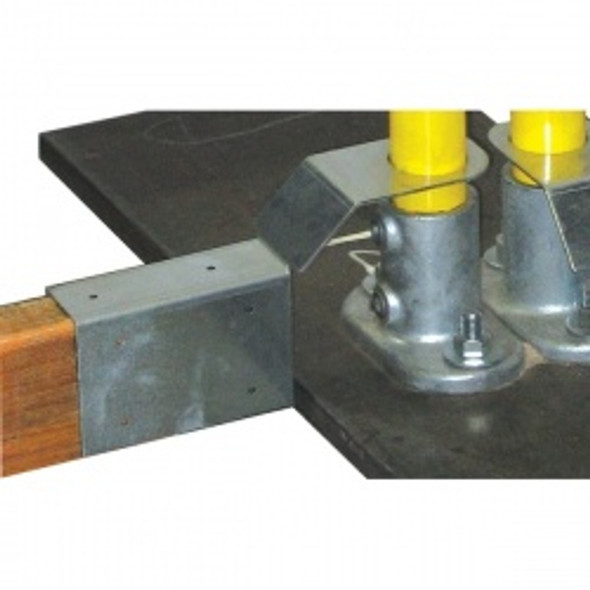
Long Toe-Board Attachment 22" (L) | Adaptable | Guardian Fall Protection
Guardian Fall Protection
$69.00Guardian's Toeboard Attachment is intended for use with the standard Guardrail Baseplate part # 15180 or the Guardrail Knuckle part # 15186. It requires no penetration of the substrate and is composed of hot dipped galvanized steel for increased...$69.00 -

Stair Mount For Use With 2 x 4 Boards (10" x 6" x 6") | Weather Resistance | Guardian Fall Protection
Guardian Fall Protection
$70.77A stair-mounted 2x4 guardrail post receiver Guardrail systems can be constructed using may different components, most commonly either wood or steel posts/rails. Modular systems require bases, vertical posts, and horizontal rails. The 2x4 Stair Mount...$70.77 -

Metal Adjustable Guardrail Post | Guardian Fall Protection
Guardian Fall Protection
$71.66 - $94.70A horizontal rail component of a guardrail system The Adjustable Snap-On Metal Rail is designed to be used in combination with the Guardian Universal Guardrail Post. Simply connect each end to the post rung. Ideal for modular guardrail systems that...$71.66 - $94.70 -

Guardrail Receiver For Use With Guardrail Posts | Superior Durability | Guardian Fall Protection
Guardian Fall Protection
$80.32A wall-mounted post receiver compatible with all Guardian Universal Guardrail Posts Guardrail systems can be constructed using may different components, most commonly either wood or steel posts/rails. Modular systems require bases, vertical posts, and...$80.32 -

Replacement Flag Line (105' L) | Heavy Duty Nylon Cord | Guardian Fall Protection
Guardian Fall Protection
$95.00A flag line component of a warning line system The Guardian Replacement Flag Line is compliant with the Guardian Goose and Single Stanchions, as well as the Warning Line Post, and is a component of a complete and OSHA compliant warning line system...$95.00 -


Residential Guardrail Post (42") | Lightweight | Guardian Fall Protection
Guardian Fall Protection
$95.00Guardrail post component intended for use only with the Parapet Clamp Guardrail System and Residential Guardrail System. The Residential Guardrail Post is the post component for two specific guardrail systems from Guardian. It includes to post rungs and...$95.00 -

Omg-Rail Combo Guardrail Kit | Guardian Fall Protection
Guardian Fall Protection
$95.00Omg-Rail Combo Guardrail Kit | Guardian Fall Protection Includes: (2) end rails, (2) 30" section w/flare, (2) 30" section w/o flare, (2) 52" section w/o flare6'/8'/10'$95.00 -

Guardrail Angel Boot (8 1/2" x 5 3/4" x 5 1/4") | High Strength | Guardian Fall Protection
Guardian Fall Protection
$100.17The Guardian Angel Boot functions to increase the support of a guardrail system through its durable high-strength plastic design and reinforced gussets letting it withstand even the harshest of work environments. It is easy to install can be attached to...$100.17 -

Universal Guardrail Post | Lightweight Welded Steel | Guardian Fall Protection
Guardian Fall Protection
$110.15 - $155.00The post component for a variety of Guardian guardrail receivers Guardrail systems can be constructed using may different components, most commonly either wood or steel posts/rails. Modular systems require bases, vertical posts, and horizontal rails. The...$110.15 - $155.00