

2 & 3-Piece Rain Suits
What Are 2 & 3-Piece Rain Suits?
Rain suits for work are waterproof garments that protect workers from precipitation while allowing full range of motion. A 2-piece rain suit pairs a sealed jacket with waterproof pants. A 3-piece configuration adds a detachable hood for full head and neck coverage in sustained heavy rain.
All Safety supplies heavy duty rain suits and waterproof work suits to industrial and commercial buyers across Canada.
Key Takeaways: Work Rain Suits
- Choose a 3-piece rain suit when work involves sustained exposure to heavy rain — the detachable hood provides coverage a jacket collar cannot match.
- Size rain suits to fit over all required PPE layers, including fall protection harnesses and FR coveralls.
- Hi-vis rain suits must meet CSA Z96 Class and background-material requirements when worn in traffic or road-work zones.
- PVC and poly/PVC outer shells resist abrasion better than lightweight polyurethane for heavy duty industrial environments.
- Sealed seams are the primary waterproofing failure point — inspect them before each use and after any snagging incident.
- FR-rated rain suits are required when workers face both precipitation and flash-fire or arc-flash exposure.
- Denier rating indicates shell fabric weight — higher denier means greater tear and abrasion resistance for demanding sites.
2-Piece vs. 3-Piece Rain Suit: Which Configuration Fits Your Work?
Configuration determines coverage and versatility. The table below compares the two forms across the criteria buyers most frequently raise.
2-Piece vs. 3-Piece Rain Suit Comparison
| Feature | 2-Piece Rain Suit | 3-Piece Rain Suit |
|---|---|---|
| Components | Jacket + pants | Jacket + pants + detachable hood |
| Head/neck coverage | Jacket collar only | Full hood seal around face |
| Packability | More compact | Slightly bulkier when packed |
| Best use case | Light-to-moderate rain, intermittent exposure | Heavy sustained rain, exposed worksites |
| Typical buyer | General construction, warehousing | Oil and gas, road crews, utilities |
Workers in sustained outdoor exposure — road maintenance, pipeline, and utility crews — typically require the 3-piece configuration. The 2-piece waterproof work suit suits crews with intermittent rain exposure or who need a lighter packable option.
Rain Suit Materials and CSA Standards for Canadian Worksites
Material choice drives durability, comfort, and compliance. Industrial rain suits sold in Canada must meet CSA Z96 when hi-vis features are present, with Class 2 as the minimum for traffic-control workers. FR rain suits worn in flash-fire environments must comply with CAN/CGSB-155.20.
Workers in oil and gas who face both precipitation and ignition hazards should select an FR jacket or parka rated to CAN/CGSB-155.20 rather than a standard waterproof shell.
Rain Suit Material and Spec Glossary
- PVC (polyvinyl chloride)
- Heavy outer shell material. High abrasion and chemical resistance. Heavier than polyurethane. Common in industrial rain suits for oil and gas and construction.
- Poly/PVC
- Polyester fabric laminated with PVC coating. Balances weight and durability. Most common shell in mid-grade waterproof work suits.
- Polyurethane (PU)
- Lighter, more flexible coating. Better breathability than PVC. Suited to lighter duty or high-mobility tasks.
- Denier (D)
- Fabric weight measurement. 150D suits light industrial use; 210D and above suits heavy duty environments with abrasion risk.
- Sealed seams
- Tape-sealed or welded seam construction that blocks water infiltration at stitch lines. Required for waterproof — not merely water-resistant — classification.
- CSA Z96
- Canadian standard governing high-visibility safety apparel. Specifies Class 1/2/3 ratings based on background material area and retroreflective tape placement.
- CAN/CGSB-155.20
- Canadian standard for flame-resistant clothing in flash-fire environments. Requires a maximum 40% predicted body burn and minimum 50-wash durability.
Industry Applications and Buying Process for Work Rain Suits
Rain suits for work serve every sector where crews operate outdoors. Buyer needs diverge significantly by application — the table below and buying steps reflect those differences.
Industry Applications
- Oil and gas: Pipeline and wellsite crews face sustained precipitation alongside ignition hazards — FR-rated, sealed-seam 3-piece suits are standard.
- Construction: Framing and civil crews need durable poly/PVC shells that fit over harnesses without restricting clip-in points — pair with fall protection harnesses.
- Road maintenance: Traffic-control workers require CSA Z96 Class 2 hi-vis rain suits compatible with safety vests layered underneath or overtop.
- Utilities: Line crews doing emergency repairs in storms need 3-piece suits with full hood seals and room for arc-rated underlayers.
- Forestry: Ground crews and fallers need flexible shells with reinforced knees and ankles that work with chainsaw-rated underlayers.
- Municipal services: Waste, water, and parks crews benefit from lightweight 2-piece suits for daily intermittent exposure without heat buildup.
- Industrial manufacturing: Outdoor plant operators exposed to chemical splash alongside rain require chemically resistant shells, not standard PVC.
Buying Process for Work Rain Suits
- Identify exposure type: sustained heavy rain, intermittent precipitation, or combined chemical/rain exposure.
- Determine PPE layering: size up if workers wear harnesses, FR coveralls, or hand protection underneath.
- Confirm hi-vis requirement: check whether CSA Z96 Class 2 or Class 3 applies to the work zone.
- Select shell material based on abrasion risk: PVC or 210D poly/PVC for heavy duty sites; PU for light industrial.
- Verify FR requirement: if flash-fire or arc-flash exposure exists, confirm CAN/CGSB-155.20 compliance on the garment label.
- Check gas monitor clip placement and ensure suit pockets or flaps do not obstruct detector sensors.
- Order and inspect sealed seams and zipper closures on receipt before deploying to the field.
Frequently Asked Questions About Rain Suits for Work
What is the practical difference between a 2-piece and 3-piece rain suit on a job site?
A 2-piece rain suit leaves the head and neck reliant on the jacket collar for coverage. A 3-piece adds a fully sealed detachable hood, which matters in sustained downpours or exposed conditions where collar gaps allow water infiltration at the neck. Most outdoor industrial crews default to 3-piece for extended shifts.
Can workers wear a rain suit over a fall protection harness?
Yes, but sizing is critical. A rain suit worn over a full-body fall protection harness requires at least one size larger than the worker's standard fit. Dorsal D-rings must remain accessible through the suit's back — confirm access points before purchasing.
Are heavy duty rain suits for work available with flame-resistant ratings?
Yes. FR rain suits rated to CAN/CGSB-155.20 are available for workers in oil and gas and other flash-fire environments. Standard PVC rain suits are not flame resistant and must not be worn where ignition sources are present. Confirm the garment label shows the CAN/CGSB-155.20 certification before purchase.
Quick Selection Checklist for Work Rain Suits
- Check that sealed seams run continuously through all stress points on the jacket and pants.
- Verify the hi-vis rating matches CSA Z96 Class requirements for the specific work zone.
- Assess whether the suit fits comfortably over the full PPE stack the worker wears on site.
- Confirm shell denier and material match the abrasion level of the work environment.
- Review whether FR certification (CAN/CGSB-155.20) is required before selecting a non-rated shell.
- Confirm that gas monitor clip and sensor positions remain unobstructed when the suit is worn.
- Check manufacturer wash and care instructions to plan for maintenance cycles and replacement intervals.
- Verify that zipper closures and cuff adjustments seal fully with the gloves and headwear the crew uses.
Selecting the right waterproof work suit for Canadian industrial environments means matching shell material, configuration, and certification to the actual exposure conditions workers face. Heavy duty rain suits for work built on poly/PVC or PVC shells with sealed seams handle the rigours of construction, oil and gas, and utility sites. Hi-vis models must satisfy CSA Z96 Class requirements, and any site with ignition risk requires a CAN/CGSB-155.20-rated FR shell rather than a standard waterproof garment. Size to fit over all required PPE layers, confirm harness access points, and inspect sealed seams before each deployment to maintain protection throughout the suit's service life.
- Product
- Qty in Cart
- Quantity
- Price
- Subtotal
-


Hi-Vis FR Element Series 3-Piece Rain Suit | RanPro
RanPro
$165.91Description Material and all components meet CGSB 155.20 2000 Type 3 CSA Z96 striping package featuring retroreflective striping Permanently welded seams Jacket is CSA Z96-15 Class 2 Level 2 jacket...$165.91 -


Supported PVC Rain Suit | 3-Piece Set with Hangable Bag | Pioneer
Pioneer Workwear
$25.79Description This 3-piece set includes a rain jacket detachable hood and bib pant made of PVC/polyester material offering 100% waterproof and windproof protection. The heavy-duty raincoat has 2 large...$25.79 -


Hi-Vis Lightweight 2-Piece Rain Suit | Pioneer
Pioneer Workwear
$64.08Description The Pioneer waterproof lightweight safety rain suit will help you stay active dry and protected even in the toughest weather conditions. Built with rugged materials and a functional...$64.08 -
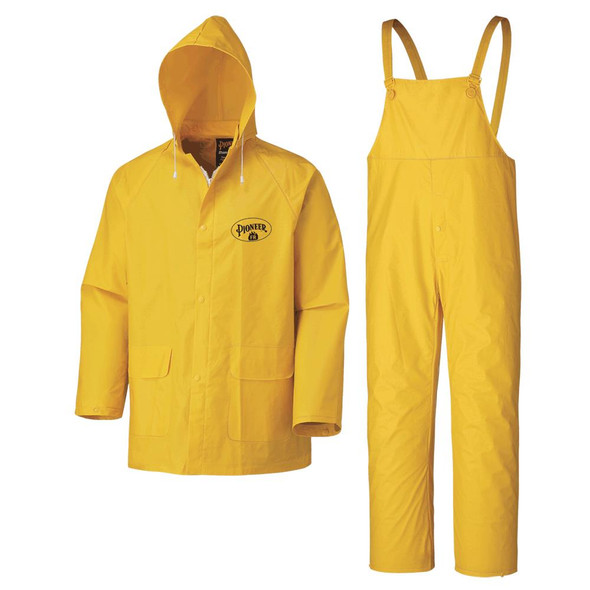

Fire Resistant 3-Piece PVC Rain Suit | Yellow | Pioneer
Pioneer Workwear
$29.09Description 2 pieces: jacket with zip and snap front placket detachable snap hood and bib pant with self fabric suspenders 2 patch pockets 100% waterproof .35 mm FR treated PVC/poly/PVC Meets CGSB...$29.09 -


FR Heavy Duty PVC Rain Suit | 3-Piece | Pioneer
Pioneer Workwear
$69.52Description 3 pieces: jacket with snaps and detachable snap hood double bib reversible pant with elastic suspenders Heavy-duty .45 mm FR treated PVC/polyester/PVC 100% waterproof Meets CGSB 155.20...$69.52