Corlyn Gagne Found What She Needed at All Safety - Knowledgeable Staff and Fast Delivery
Why Knowledgeable Staff Changed Corlyn Gagne's Safety Supply Experience
Walking into a safety supply store — or scrolling through a catalog alone — leaves most buyers guessing. The products look similar. The labels are dense. Pick the wrong spec, and you find out at an inspection, not before it.
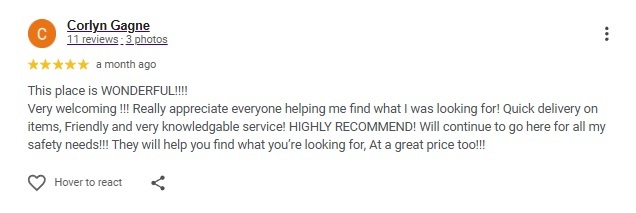
"This place is WONDERFUL!!!! Very welcoming !!! Really appreciate everyone helping me find what I was looking for! Quick delivery on items, Friendly and very knowledgable service! HIGHLY RECOMMEND! Will continue to go here for all my safety needs!!! They will help you find what you're looking for, At a great price too!!!" - Review by Corlyn Gagne
The Friction Most Safety Buyers Face Before Finding the Right Supplier
Finding a safety equipment supplier in Canada means working with staff who know which product fits the job. All Safety, based in Edmonton, Alberta, carries over 8,000 products and ships across Canada and the United States. Corlyn Gagne's experience here captures what separates a good supplier: product knowledge, fast delivery, and competitive pricing.
That combination matters most when the stakes are high. A buyer who leaves with the wrong product — because no one on the floor understood the application — doesn't discover the problem at the checkout. They discover it on site, under pressure, when it's already too late to reorder.
How Does All Safety Compare to Buying Safety Gear Without Staff Help?
Staff-Guided Purchase vs. Unassisted Purchase: What Changes
| Factor | Buying Without Staff Guidance | Buying With Knowledgeable Staff |
|---|---|---|
| Product spec accuracy | Depends on buyer's prior knowledge of standards | Staff matches product to job requirement and applicable standard |
| Risk of wrong purchase | Higher — classification errors are common without guidance | Lower — spec confirmed before the order is placed |
| Time to correct order | Return + reorder cycle adds days or weeks | Right product ships on the first order |
| Compliance confidence | Uncertain — buyer interprets the label alone | Confirmed — staff identifies the correct class or rating |
| Pricing visibility | Listed price only — no volume context | Volume discount tiers available from $250+ |
How Safety Product Expertise Reduces Compliance Risk on the Job
When a Product Looks Compliant But Isn't: The Real Cost of Spec Errors
Think of a knowledgeable safety supplier the way you think of a pharmacist rather than a cashier. Both work with products that look similar on the shelf. The difference is that one of them understands which option matches your specific condition — and which one doesn't. When a site manager asks you to verify the cut resistance rating of the gloves you ordered, can you answer with confidence?
Most product labels carry a certification mark, but that mark tells you a product passed a test — not whether it passed the right test for your application. A buyer without guidance typically selects by appearance, price, or brand familiarity. That works when the margin for error is wide. It fails when it isn't.
Two Common Safety Product Selection Errors and Their Consequences
Hard hat class confusion is one of the most frequent errors in Canadian worksites. CSA Z94.1 defines three electrical protection classes: Class E protects against up to 20,000 volts, Class G protects against up to 2,200 volts, and Class C provides no electrical protection at all. Both Class E and Class G hard hats look identical on the shelf. A buyer who selects Class G for an electrical zone requiring Class E hasn't bought a substandard product — they've bought the wrong one entirely.
Glove cut level selection follows the same pattern. Under ANSI/ISEA 105, cut resistance runs from A1 through A9. A cut-A2 coated glove is common and inexpensive. It handles light-duty tasks. On a sheet metal handling job or a glass fabrication line — where A4 or A5 resistance is typically required — it offers incomplete protection. The product meets its stated standard. It just doesn't meet the job's requirement.
How 25 Years of Industry Experience Supports Corlyn Gagne's Outcome
Corlyn described "knowledgeable service" — and that phrase points to something specific. A supplier who stocks 8,000+ products across categories including cut-resistant and impact gloves for industrial work, CSA-certified hard hats for construction and electrical work, and gas monitors for confined space and oil and gas applications has staff who field these questions every day. Over time, that repetition builds the kind of pattern recognition that catches a wrong-spec order before it ships.
All Safety — an Edmonton-based safety supply company serving construction, oil and gas, manufacturing, and utilities clients across Canada and the US — draws on over 25 years of industry experience to guide product recommendations. That experience is the operational backbone behind Corlyn's "found what I was looking for" outcome. She didn't have to know the classification system. The staff did.
How All Safety Fulfills Orders and When This Supplier Fits Your Operation
The Five Steps From Safety Requirement to Delivered Product
Most supplier failures happen at a specific point in the process — not everywhere at once. Mapping the fulfillment workflow lets you identify where your current supplier falls short. At which step does your current supplier typically fail you — the product knowledge, the order process, or the delivery follow-through?
All Safety's Order Fulfillment Workflow
- Identify the requirement: You describe the job, the hazard, or the compliance requirement — in-store, by phone, or online. Staff works from the application, not just the product name.
- Product matching: Staff uses product knowledge and industry experience to confirm the right item — correct standard, class, and specification for the task at hand.
- Order placement: You place the order in-store or through the online platform. If you need the order by a specific date, enter it in the Order Comments field at checkout.
- Warehouse routing: All Safety ships from the nearest warehouse with available stock. When stock requires a transfer between warehouses, that step happens before the shipment is initiated.
- Delivery and follow-up: The carrier dispatches the order. All Safety follows up with the delivery company to monitor arrival and resolve delays.
Shipping Tiers, Pricing, and Returns
Freight rates calculate at checkout based on your location. Volume discount tiers apply automatically: orders over $250 qualify for free shipping; $500+ adds a 5% discount; $1,000+ adds 7%; $2,000+ adds 10%. Returns are accepted within 30 days of receipt for unused items in original packaging. A 20% restocking fee may apply to returns — it does not apply to exchanges. All Safety cannot guarantee every shipment arrives on time, but the company follows up with carriers directly to minimize delays.
For buyers evaluating total cost, it helps to read what to look for in a Canadian safety equipment supplier before comparing quotes. A slightly lower per-unit price from a supplier with poor guidance often costs more in the return cycle than a fair price from one who gets the spec right the first time. All Safety also offers gas monitor calibration and repair services and fall protection equipment rentals — useful if your requirement is short-term and a purchase doesn't make sense. For larger operations, hi-vis and flame-resistant coveralls for industrial use and similar high-volume items benefit most from the upper discount tiers.
When All Safety Is and Isn't the Right Fit
Switching to a new supplier carries real friction. You need to qualify the vendor, update procurement records, brief staff on a new ordering platform, and accept that the first few orders will reveal process gaps you didn't know existed. There is no guarantee the new supplier won't introduce its own problems — delayed shipments, back-ordered items, or staff turnover that erases the product knowledge you relied on. That friction is real, and it's worth weighing honestly before you act on a positive review.
All Safety fits operations that order regularly, value guidance on product specifications, and ship to locations across Canada or the US. It works well for construction firms, oil and gas operators, and manufacturing facilities that need a consistent source for PPE and compliance equipment. It is less suited to buyers who need a single specialty item in a very small quantity on the same day — a local industrial counter with walk-in inventory typically resolves that faster than a warehouse-routed order. Large national distributors and big-box industrial retailers also offer broader geographic coverage and same-day local pickup in some markets, which matters for last-minute, single-item needs.
Businesses facing recurring safety supply requirements — equipment sourcing, delivery coordination, or compliance equipment maintenance — can work with All Safety to consolidate those needs under a single supplier relationship.
Recent Posts
-
Corlyn Gagne Found What She Needed at All Safety - Knowledgeable Staff and Fast Delivery
Why Knowledgeable Staff Changed Corlyn Gagne's Safety Supply Experience Walking into a safety supply …2026 Apr 29th -
Jesse Markey on All Safety: One-Stop Safety Supply with Expert Staff
Jesse Markey on All Safety: One-Stop Safety Supply with Expert Staff When your supplier doesn't ask …2026 Apr 29th -
How to Choose a Quality Safety Equipment Supplier in Canada: Essential Criteria for 2026
A quality safety equipment supplier provides certified products meeting Canadian standards, expert g …2025 Jul 29th