Jesse Markey on All Safety: One-Stop Safety Supply with Expert Staff
Jesse Markey on All Safety: One-Stop Safety Supply with Expert Staff
When your supplier doesn't ask the right questions
The problem usually surfaces at the worst moment — a site inspection, a near-miss, or a failed audit. A piece of PPE you ordered in good faith turns out to be the wrong protection class for the hazard. Your supplier filled the order. Nobody asked what you were actually protecting against.
What Jesse Markey Found at All Safety
"Dawson goes above and beyond to deliver outstanding customer service, consistently prioritizing his customers' needs. At All Safety, you're not just getting fantastic prices, but also the convenience of finding all your safety equipment needs in one place. The team is incredibly knowledgeable, offering expert advice to ensure you make the right choices, and they foster a genuinely friendly and welcoming environment. It's clear that customer satisfaction is their top priority. If there were an option to give 10 stars, I wouldn't hesitate -All Safety truly sets the bar for excellence in the safety equipment industry!" - Review by Jesse Markey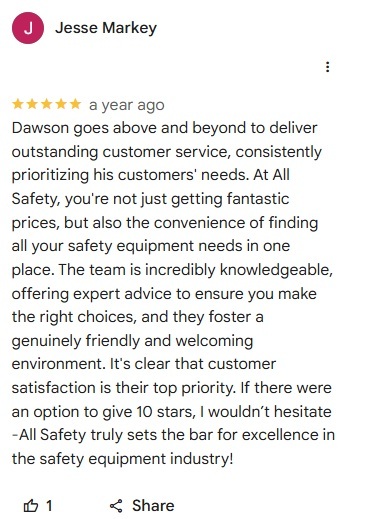
A reliable safety equipment supplier in Canada provides more than product availability — staff expertise, consolidated inventory, and competitive pricing work together to reduce procurement friction and compliance risk. All Safety stocks over 8,000 products with knowledgeable staff who help buyers match equipment to specific job site requirements and applicable standards, including CSA and ANSI classifications.
Jesse Markey's review names Dawson specifically — not as a generic positive signal, but as evidence of what a well-staffed safety supplier actually delivers. Notice the sequence: Jesse mentions expert advice that confirmed the right choices before mentioning the convenience of finding everything in one place. The guidance came first. The catalog breadth was secondary. That order matters when you're evaluating whether a supplier's knowledge depth is real or just a talking point.
Which safety supplier problem are you actually trying to solve?
Most buyers approach supplier evaluation with one dominant concern. Identifying yours shapes what you should actually scrutinize in a prospective vendor.
- Pricing and volume discounts. Evaluate bulk discount thresholds, freight costs at your typical order size, and return policy terms. All Safety applies discounts automatically at $250, $500, $1,000, and $2,000 order thresholds — free shipping starts at $250, and the discount rate increases with volume.
- One source for all equipment categories. Evaluate catalog breadth across all the categories your crews use — PPE, gas detection, fall protection, fire safety, first aid. A supplier who covers 20+ categories eliminates the overhead of managing separate vendor relationships for each hazard type.
- Expert guidance to avoid compliance errors. Evaluate staff knowledge depth specifically — not just response time. Ask about standards. If the rep can reference the applicable CSA class or ANSI rating for a product without looking it up, that's a meaningful signal. If they can't, your compliance exposure doesn't shrink just because the catalog is large.
How to evaluate a safety equipment supplier in Canada
The procurement process most safety buyers follow
All Safety serves commercial and industrial buyers across Canada and the US, providing safety equipment for construction, oil and gas, manufacturing, and related industries. Understanding where most procurement processes break down helps buyers ask the right questions before committing to a vendor. The steps below reflect how most safety equipment purchases actually move from need to deployment — and where supplier gaps create the most risk.
You can learn more about how to evaluate a safety supply vendor in Canada to build a more structured assessment before switching suppliers.
- Identify the need. Determine the equipment category, the specific hazard, and the applicable standard before searching for products. Skipping this step is where most mismatch errors begin.
- Access the supplier's catalog. A consolidated catalog covering 20+ safety categories reduces the chance you'll need a second vendor to fill gaps. All Safety carries 8,000+ SKUs across PPE, gas detection, fall protection, fire safety, and more.
- Consult staff for guidance. This is the step most e-commerce suppliers skip entirely. Staff who can cross-reference a product against its CSA or ANSI rating — and flag when a selection doesn't match the hazard — function as an informal compliance layer at the point of purchase.
- Confirm selections against site requirements. Before placing the order, verify that chosen products meet the applicable standard for the job site. CSA Z94.1 for head protection, CSA Z195 for footwear, ANSI/ISEA 105 for hand protection cut ratings — the standard depends on the hazard.
- Place the order with volume pricing applied. Orders over $250 qualify for free shipping. Discounts scale at $500 (5% off), $1,000 (7% off), and $2,000 (10% off), applied automatically at checkout.
- Receive and deploy. All Safety ships from the nearest warehouse with available stock. Delivery timelines are communicated at order placement, and the team monitors shipments and follows up with carriers on delayed orders.
Where e-commerce safety suppliers don't always fit
Switching to a new supplier carries real friction — time spent qualifying the vendor, re-entering addresses and account information, updating procurement records, and training staff on a different ordering system. There is genuine risk that the new supplier introduces its own problems: slower-than-expected delivery on a first order, stock gaps on a product you assumed was always available, or a return process that's more complicated than your current one. Those risks are real and worth weighing seriously before you commit.
Large distributors and regional safety supply chains offer similar product ranges and may carry more local inventory for same-day pickup — a meaningful advantage when a job site has an urgent, unplanned need. Buyers with very small, one-off orders or same-day local pickup requirements may find that a nearby brick-and-mortar safety supplier serves their immediate timeline better than an e-commerce model, regardless of catalog size or staff expertise. The e-commerce model works best for buyers with predictable order cycles and lead time tolerance, not for emergency restocking runs.
What NET30 terms and custom portals change for procurement teams
For operations with multiple buyers, multiple sites, or recurring safety equipment needs, the ordering structure matters as much as the product catalog. All Safety offers custom online ordering portals with approved product catalogs, fixed contract pricing, and user-specific spending limits — available as a Basic plan or a Premium plan that includes a white-labeled site with your company's branding. Both plans support NET30 invoicing, which removes the overhead of credit card reconciliation and keeps procurement visible to your accounting team at the invoice level rather than the transaction level.
What expert safety equipment advice actually looks like
What Dawson's product guidance means in practice
Think of a knowledgeable safety equipment staff member the way you'd think of a pharmacist. A pharmacist doesn't just hand you what you asked for — they check that the product fits the condition, flag interactions you didn't know to ask about, and catch the cases where a buyer's familiarity with one product leads them to reach for the wrong one. That's the function Dawson performs at All Safety, and it's what Jesse Markey describes: advice that confirmed the right choices before the purchase, not a return and reorder after a problem surfaced on site.
When was the last time your safety supplier asked what hazard you were actually protecting against — not just what size glove you needed? Selecting cut-resistant gloves matched to the right ANSI cut rating for the actual task, rather than defaulting to the most familiar option, is the kind of guidance that prevents the quiet compliance errors that don't show up until an injury or inspection.
Two product selection errors that show up often
How many of your current PPE selections were confirmed against the applicable CSA or ANSI standard — and how many were made based on habit, familiarity, or price? Two categories where mismatch errors are common in industrial purchasing:
Respirator class selection. Disposable N95 respirators meet NIOSH requirements for particulate filtration but provide no protection against organic vapors or chemical gases. Atmospheres with solvent exposure, hydrogen sulfide, or other chemical hazards require a half-mask or full-face respirator with the correct cartridge rated per CSA Z94.4 — typically an OV/P100 combination for mixed hazards. Buyers who routinely stock N95s for general site use and apply them to tasks that require cartridge-equipped gas monitors matched to the detected atmosphere are operating with a protection gap that a knowledgeable supplier will flag.
Glove cut rating selection. Cut A2 gloves (per ANSI/ISEA 105) are widely stocked and appropriate for light assembly or general handling. Fabrication work, sheet metal handling, glass work, and many industrial cutting tasks require cut A4 or A5 rated gloves — the difference in cut resistance between A2 and A4 is significant. Buyers who generalize to cut A2 across all hand-hazard applications because it's what they've always ordered are accepting a compliance gap. The same logic applies to coveralls selected for the correct hazard class — FR-rated versus standard, and arc flash ATPV rating versus flash-fire protection, are not interchangeable.
The case for putting expertise before price
The common assumption is that the main advantage of a one-stop safety supplier is administrative convenience — fewer vendors, simpler invoicing, one account contact. Convenience is real, but it's not the primary benefit. The primary benefit is that expert staff at the ordering stage function as a compliance control. One wrong-grade product selected across a crew of twenty workers doesn't just carry the cost of a replacement order. It carries the cost of the exposure window, the compliance audit finding, and the liability if the gap is discovered after an incident rather than before it.
Jesse Markey's sequence in the review — expertise first, convenience second — reflects that priority accurately. All Safety's staff, built on over 25 years of industry experience, provide the same guidance to buyers who know exactly what they need and buyers who aren't sure. Buyers who want to explore hard hats rated for the correct electrical class for their specific site conditions, or who need to assess whether gas monitor calibration and repair services or fall protection equipment rental programs are the more cost-effective route for a short-term project, can get that guidance from the same supplier handling the product order.
Recent Posts
-
Corlyn Gagne Found What She Needed at All Safety - Knowledgeable Staff and Fast Delivery
Why Knowledgeable Staff Changed Corlyn Gagne's Safety Supply Experience Walking into a safety supply …2026 Apr 29th -
Jesse Markey on All Safety: One-Stop Safety Supply with Expert Staff
Jesse Markey on All Safety: One-Stop Safety Supply with Expert Staff When your supplier doesn't ask …2026 Apr 29th -
How to Choose a Quality Safety Equipment Supplier in Canada: Essential Criteria for 2026
A quality safety equipment supplier provides certified products meeting Canadian standards, expert g …2025 Jul 29th